$88,421 in scholarship and stipends at SMU (her dream school) plus Honors Program acceptance
Chose: Southern Methodist University
Ava was the kind of student who breaks the “she’s just not a tester” myth in half.
4.0 GPA. Straight A’s. AP classes. The work ethic was obvious. The 22 on the ACT didn’t reflect any of that, and so she’d done what a lot of strong students do when standardized tests don’t go their way: she’d quietly decided that maybe tests just weren’t her thing.
That story was wrong, but it took a couple of weeks of work to convince her.
What was actually happening
Ava had two problems, and they weren’t the ones she thought she had.
The first was Math. Long word problems—the kind that take up half a page and bury the actual math inside a paragraph of context—were eating her clock and her confidence. She’d see them, freeze for thirty seconds, and either guess or skip. Compounded across a section, the cost was huge.
The second was Reading, and Reading was actually the bigger leak. Ava was falling for the ACT’s classic trap: spending too much time carefully reading the passages and then running out of time on the questions. The result was a section where she understood the passage well but still missed questions because she didn’t have time to look back for the specific details.
Neither of these gets fixed by a content review. Both get fixed by changing the approach.
The Reading reset
We rebuilt Ava’s Reading approach from the ground up. Less time on the passage initially. More time finding the specific lines and details that questions actually asked about. Less general comprehension, more targeted retrieval.
The hard part: in the first week of practice, her Reading scores dropped. The new approach felt unnatural. She was being asked to trust a method that hadn’t started paying off yet, and the immediate feedback loop was negative.
That’s the moment that ends a lot of prep journeys for high-achieving kids. They trust the data they can see—the temporary dip—more than they trust the strategy underneath.
Ava stuck with it. By the end of week two, the new approach started working. By week three, it had clicked.
The Math drills
Math got the same surgical treatment. We pulled the specific question types she was missing and drilled them until they became automatic. Long word problems got broken into a repeatable process: identify the question, extract the math, ignore everything else. The freeze-and-skip pattern dissolved.
October test
Ava walked into the October ACT 6 weeks after starting the program. She scored a 30. Math 29, Reading 34—the section she’d been losing points on the most was now her strongest.
“Hey Carson, sorry for taking so long to respond, it’s been a busy few days, but my acceptance letter from SMU came in the mail the other day!! I earned a scholarship of $80,000! And with a couple other stipends, I’ll get over $88,000 total. And today, I just got my acceptance into their Honors Program too! I was originally going to consider my other acceptances, but now I’m definitely going to SMU 🏇”
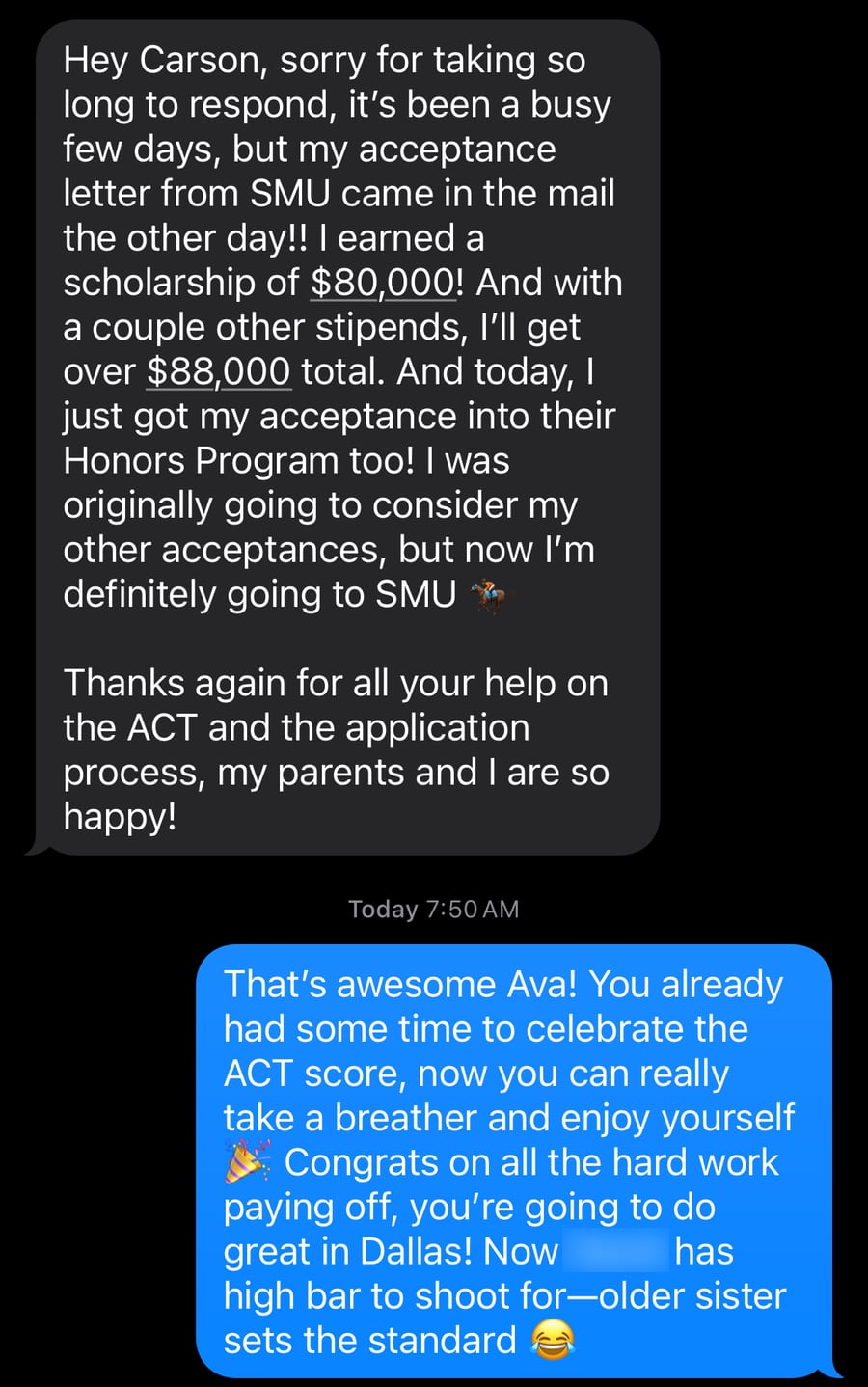
SMU was her dream school. Before the score, the conversation in her family had been about whether she’d even get in. After the score, it was about which acceptance to choose. She chose SMU.
What Ava’s story shows
“My kid just isn’t a tester” is almost never actually true. It’s usually that the prep they’ve done so far hasn’t addressed the specific way they’re losing points. Targeted strategy fixes that. Sometimes in a matter of weeks.
If your student is a strong kid in everything else but can’t seem to convert that into a test score, this is the version of that conversation where it gets solved.
"Hey Carson, sorry for taking so long to respond, it's been a busy few days, but my acceptance letter from SMU came in the mail the other day!! I earned a scholarship of $80,000! And with a couple other stipends, I'll get over $88,000 total. And today, I just got my acceptance into their Honors Program too!"
— Ava, Student
What we did differently
- Identified that math wasn't the actual problem — Reading was, and the prep she'd done so far hadn't fixed the timing trap.
- Completely rebuilt her Reading approach: less time reading the passage initially, more time finding the specific details questions ask about.
- Drilled the specific Math question types she was missing (long word problems and pacing) until solving became automatic.
- Had her trust the process through a temporary regression on Reading drills before the new approach clicked.
- Built the 6-week plan around ~15 hours/week given the tight timeline.
Coached by
Boosted Brains coaching team
Every Boosted Brains coach has a perfect or near-perfect ACT score and has been personally trained by Carson Weekley (perfect 36) and Martin (Head of Student Success).