⚖️ Honest Comparison

Princeton Review vs Boosted Brains: An Honest ACT Prep Comparison

Boosted Brains is the better fit if your student needs personalized ACT coaching with a 4–8 week finish line and daily feedback from a coach who scored 34+. Princeton Review is the better fit if your student learns best in a classroom and wants the lowest-commitment way to get introduced to the test.

Both companies have helped thousands of students, and they use fundamentally different mechanisms. Classroom instruction works for some students. Sprint coaching works for others. Below is the unfiltered side-by-side.

Updated May 2026
Book a Free ACT Gameplan Call

Looking for a Princeton Review alternative? Here's the side-by-side.

📋 Side by Side

Princeton Review vs Boosted Brains at a Glance

Pricing, format, support, and timeline, line by line.

Princeton Review Boosted Brains
Pricing model Per-course or hourly private tutoring; rates vary by package and location Flat program fee tied to current score, target score, and timeline
Primary format Group classroom courses (in-person or live online) with optional add-on private tutoring 1-on-1 sprint coaching, 100% personalized to one student's diagnostic
Personalization Same curriculum for every student in the course Every drill targets the specific question types this student misses
Daily commitment Classroom sessions plus homework; varies by package About an hour a day on average, scaled up or down based on the student's schedule and goals
Coach support between sessions Limited to the next scheduled class or tutoring block Daily async messaging, students get answers the same day
Coach credentials Varies by instructor and location Every coach scored 34+ on the ACT (most 35–36)
Tests covered ACT, SAT, GRE, MCAT, LSAT, and others ACT (plus college advising as a related service)
Score guarantee Score-improvement guarantee on most paid courses (terms vary) 4-point improvement guarantee with refund
Typical timeline Multi-week classroom courses, often spread over 1–3 months 4–8 week sprints, designed around a specific test date
Best for Students who learn well in peer groups and want a low-commitment intro to the test Students who want personalized strategy, daily feedback, and a clear finish line
Where They Win

When Princeton Review Is the Better Choice

Princeton Review has been running ACT prep for decades, and there are three real situations where their model is the right call.

  • Your student genuinely thrives in peer-group settings. Some students learn better watching other kids answer questions, hearing the back-and-forth, and getting that classroom energy. If that describes your child, a Princeton Review classroom course can be a great environment.
  • You want the lowest-commitment way to get introduced to the ACT. A multi-week classroom course is a relatively low-touch way to expose your student to the format and content before deciding whether to invest in something more intensive. It can be a useful first step.
  • You need prep across many tests over many years. Princeton Review prepares students for the ACT, SAT, GRE, MCAT, LSAT, and more. If you're thinking about a multi-year relationship across multiple standardized tests, the broader catalog matters. We're focused on the ACT (with college advising as a related service).
🎯 Where We Win

When Boosted Brains Is the Better Choice

If any of these describe your situation, sprint coaching will outperform a classroom course.

  • Your student doesn't fit the average. If they're already strong in math but losing points on reading timing, a classroom that teaches everyone the same math content is mostly wasted hours. Sprint coaching builds the plan around their specific diagnostic.
  • You've already tried a classroom course and the score didn't move. This is the most common reason families switch to us. A class taught at the average pace can't move a student who needs targeted work on three specific question types.
  • The test date is 4–8 weeks away. The whole program is built around that timeline. Multi-month classroom courses lose intensity. Sprint coaching maintains it.
  • Your student is busy with sports, AP load, or both. Ryder finished his ACT during football season as a junior. Charlie did it during lacrosse season. The hour-a-day structure fits around real life, and async coach support means no wasted commute to a classroom.
  • You need the score to move 5+ points to unlock specific scholarships. Generic prep at that scale takes many months and produces inconsistent results. Sprint coaching at this magnitude is where targeted, daily, personalized work earns its keep.
📈 Real Students

Two Students Who Came to Us After a Classroom Course Didn't Work

Specific students. Specific scores. Specific outcomes.

24 → 34

Brown

8 weeks of program · Continued improving after · $60,000 scholarship at Auburn

Brown started in a group ACT class where the teacher spoon-fed solutions in hours-long group lectures. She kept missing the same questions repeatedly, but the class moved at its own pace, spending tons of time on topics she already knew and barely any on her specific weaknesses. Mom listened to her complain about how boring and ineffective it was.

None of this was Brown's fault. She was an awesome student in the wrong system.

First test with us: 24 to 28. Second test: 28 to 31. She kept using the program resources for free during her school's in-school ACT testing days, and her score kept climbing: 31 to 32, then 32 to 33, then 33 to 34. Final outcome: $60,000 in scholarships at Auburn.
24 → 33

Ryder

8 weeks · Started early as a junior · Football and baseball at Johns Hopkins

Ryder couldn't afford the timeline of a multi-month classroom course. He was deep in football season as a junior, with peers telling him he was crazy for starting ACT prep that early. He needed something targeted, fast, and built around a daily schedule that fit between practices.

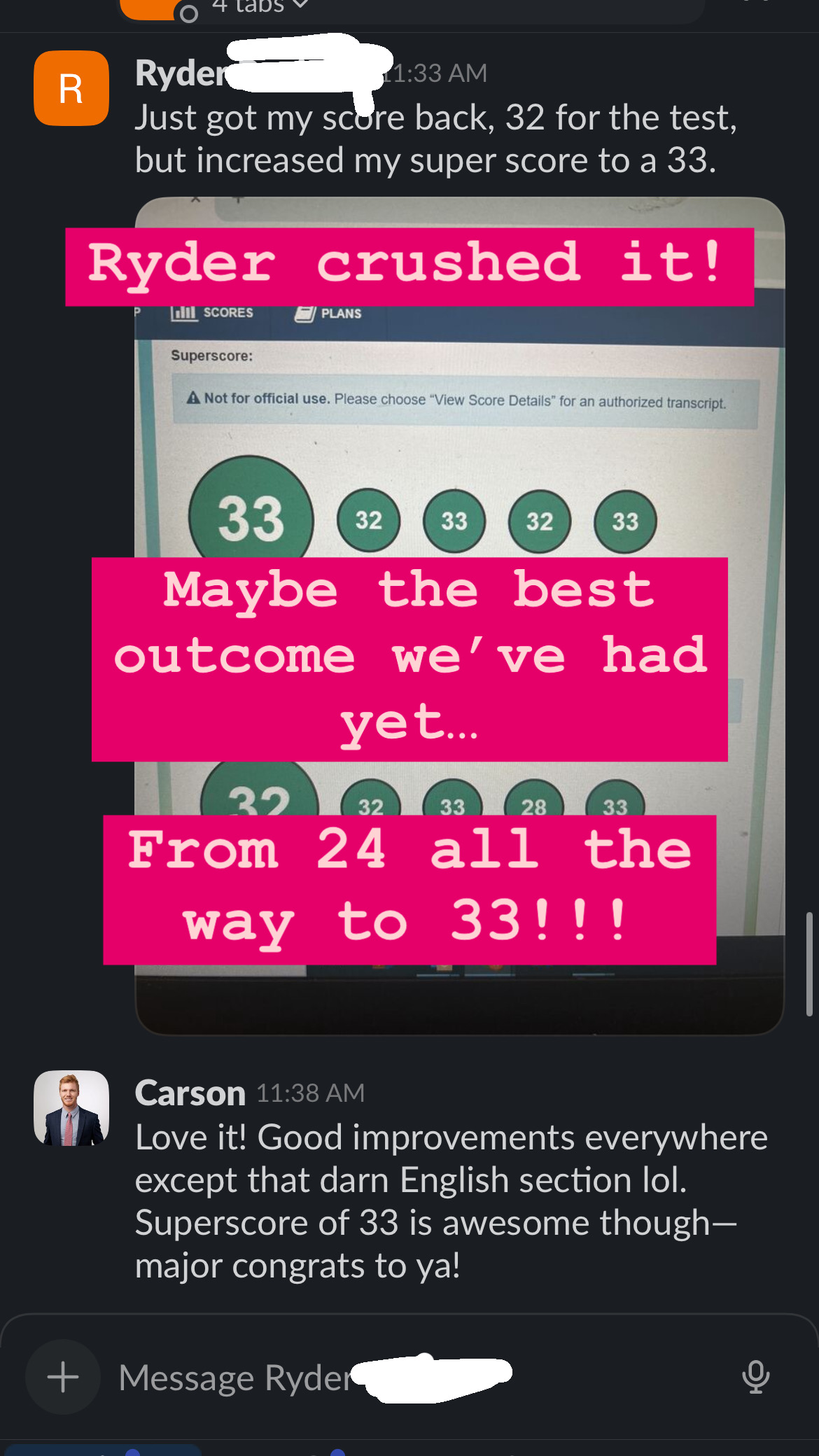
The sprint did exactly that. He finished his ACT during football season, going from a 24 to a 33 in 8 weeks. The 9-point jump opened up recruiting doors that wouldn't have been on the table at a 24.

He had offers from multiple top academic programs including UChicago. He committed to play football and baseball at Johns Hopkins. While his classmates were still stressing about the ACT in senior year, Ryder was done.

Ready to see what a personalized ACT gameplan would look like for your student?

Book a Free Gameplan Call
📍 Real Results

Real score improvements, straight from Slack

Actual screenshots from our coaching channels — unedited, unfiltered.

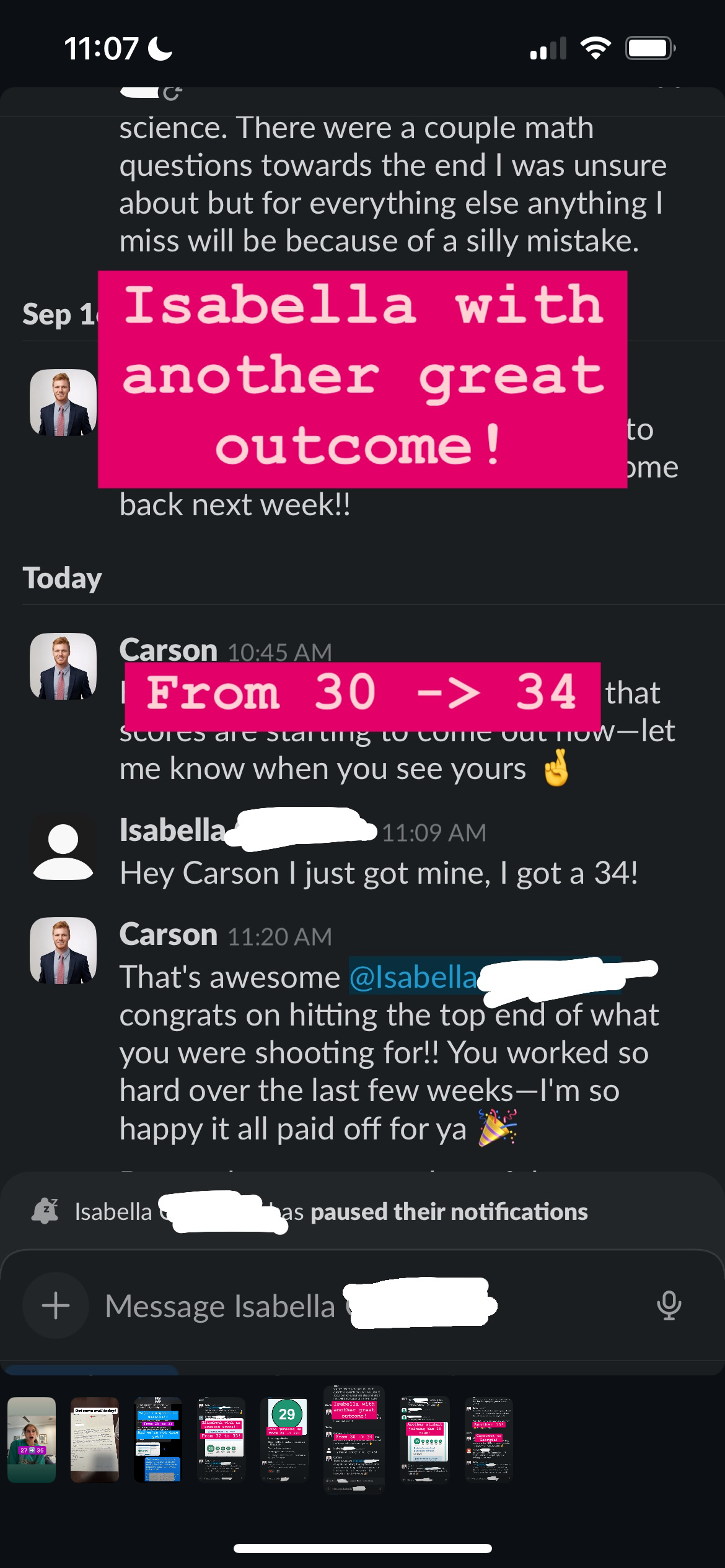
Slack screenshot - Isabella's score improvement
Verified Result
Verified Result
Actual student coaching channel
Isabella30 → 34
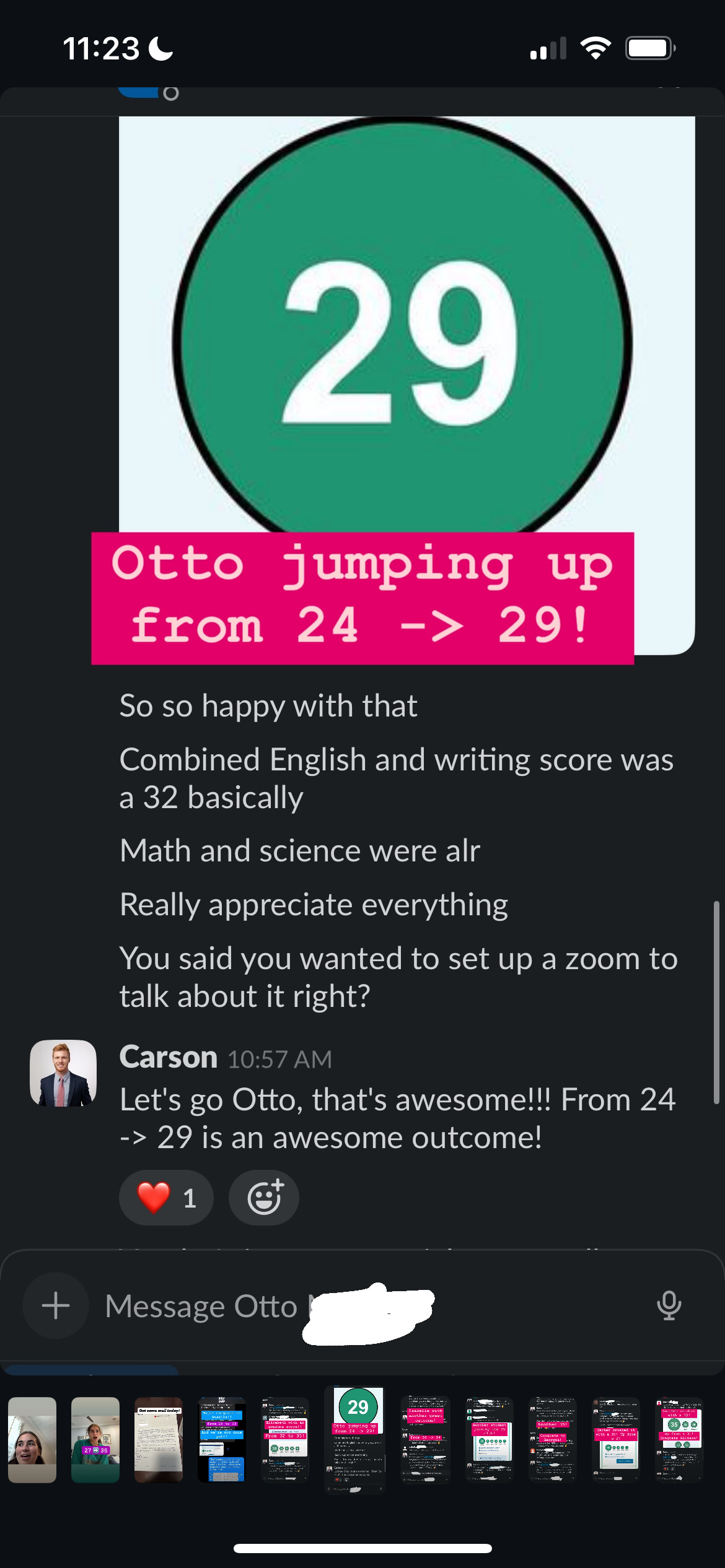
Slack screenshot - Otto's score improvement
Verified Result
Verified Result
Actual student coaching channel
Otto24 → 29
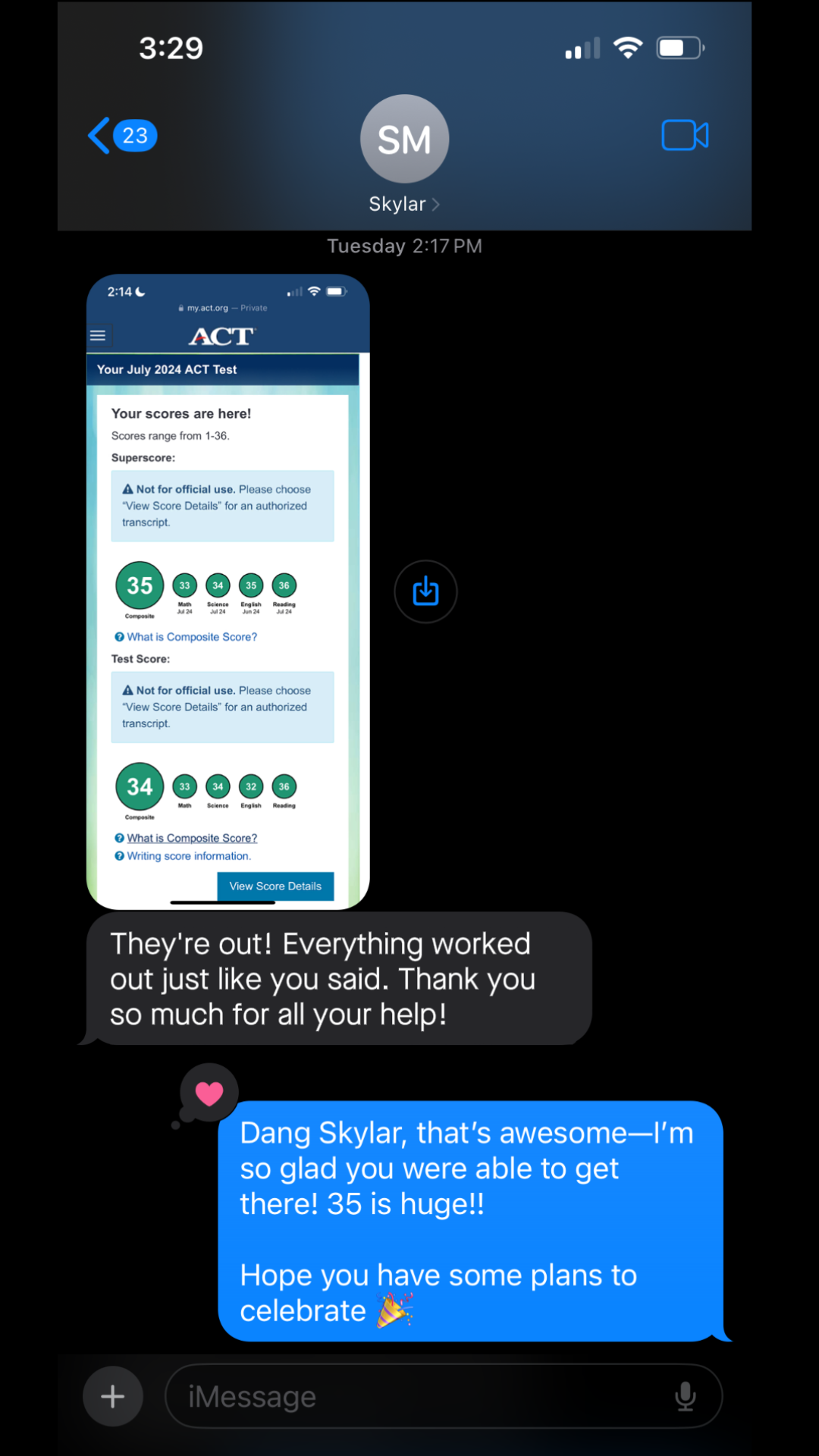
Slack screenshot - Skylar's score improvement
Verified Result
Verified Result
Actual student coaching channel
Skylar27 → 35
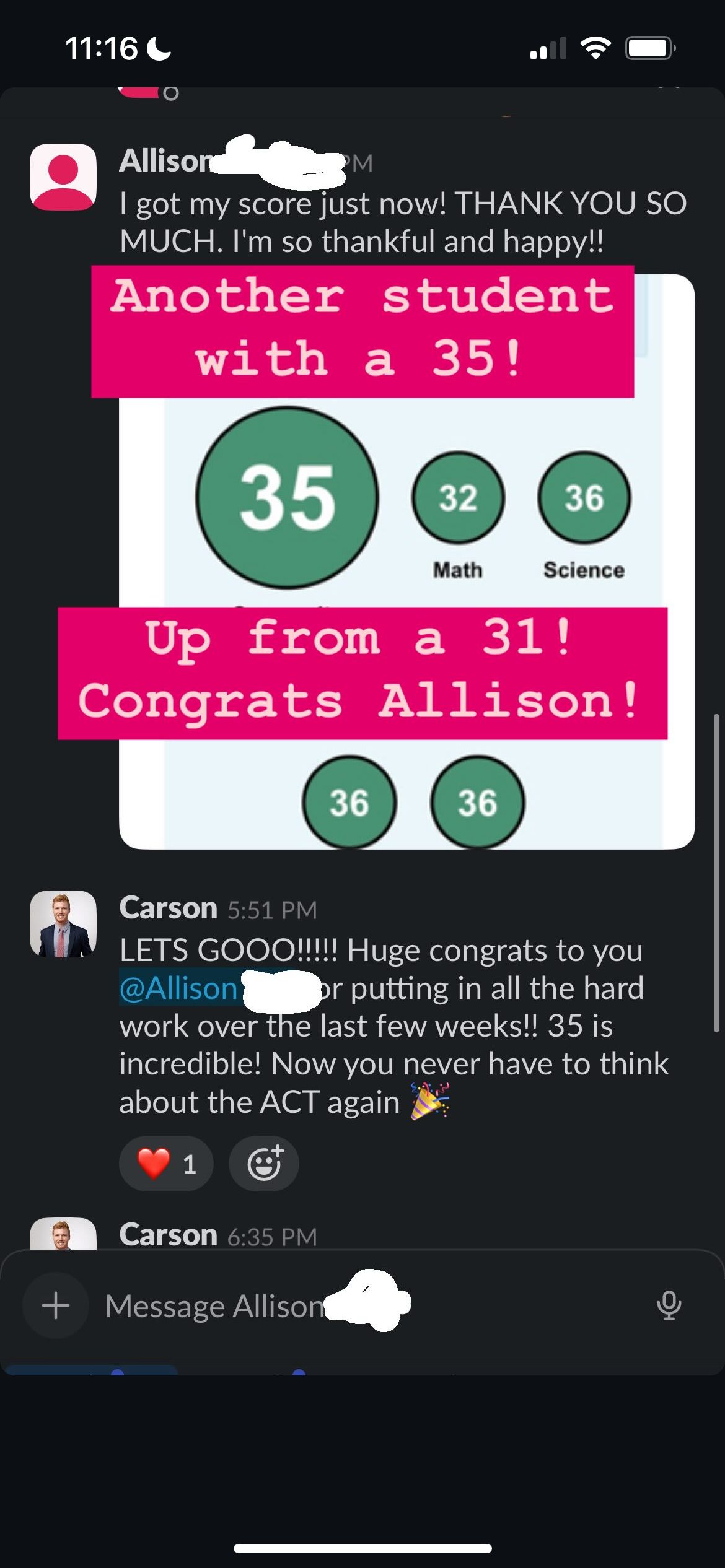
Slack screenshot - Allison's score improvement
Verified Result
Verified Result
Actual student coaching channel
Allison31 → 35
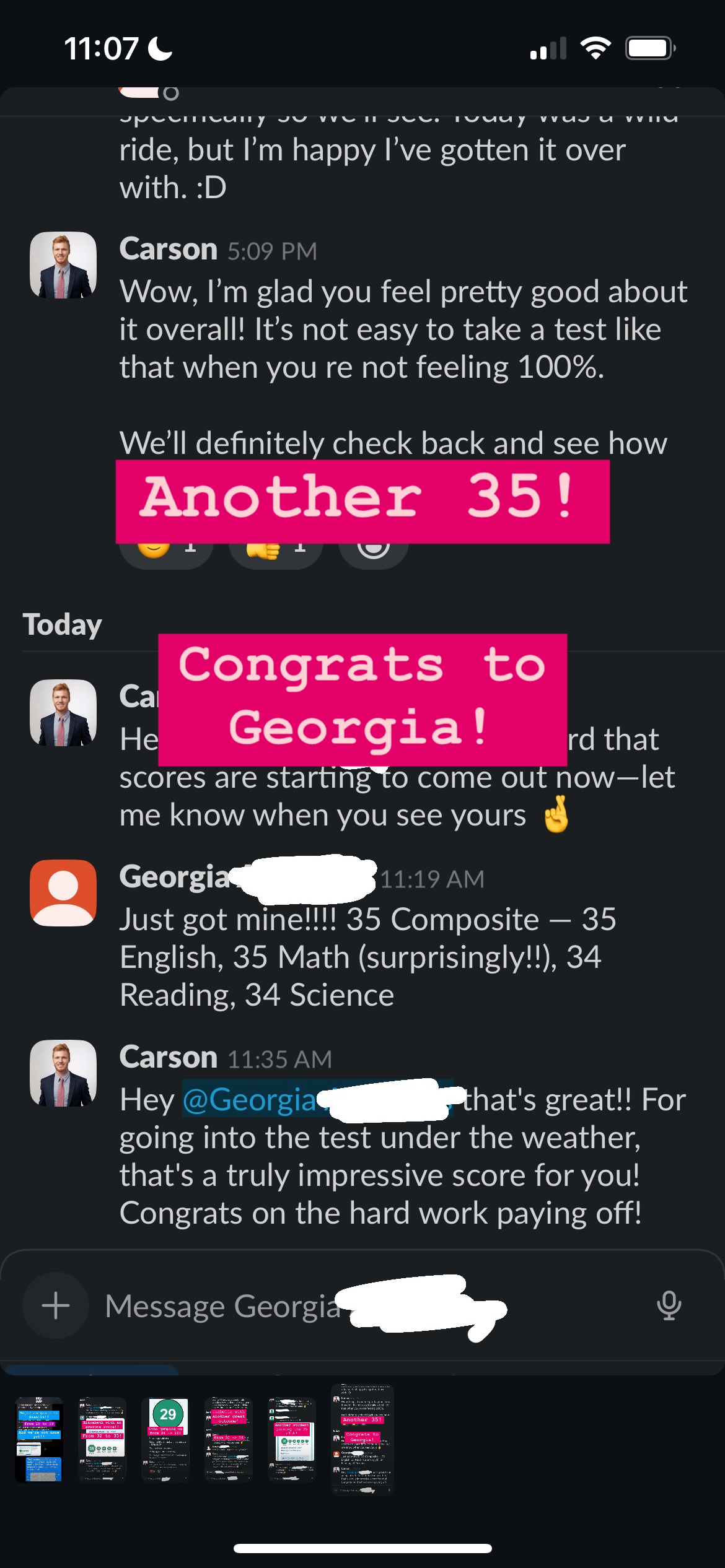
Slack screenshot - Georgia's score improvement
Verified Result
Verified Result
Actual student coaching channel
Georgia32 → 35
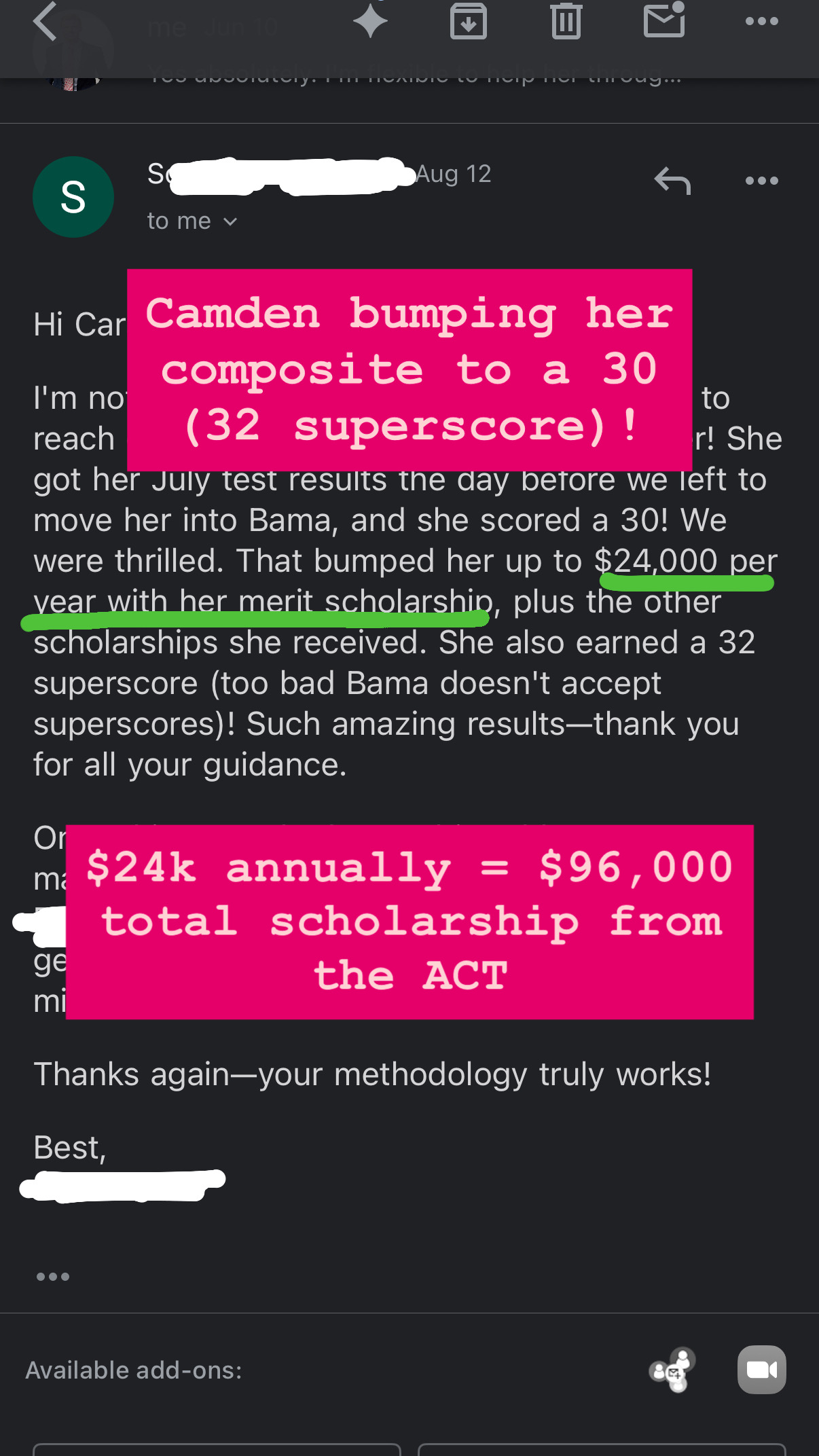
Slack screenshot - Camden's score improvement
Verified Result
Verified Result
Actual student coaching channel
Camden25 → 30
Slack screenshot - Ryder's score improvement
Verified Result
Verified Result
Actual student coaching channel
Ryder24 → 33
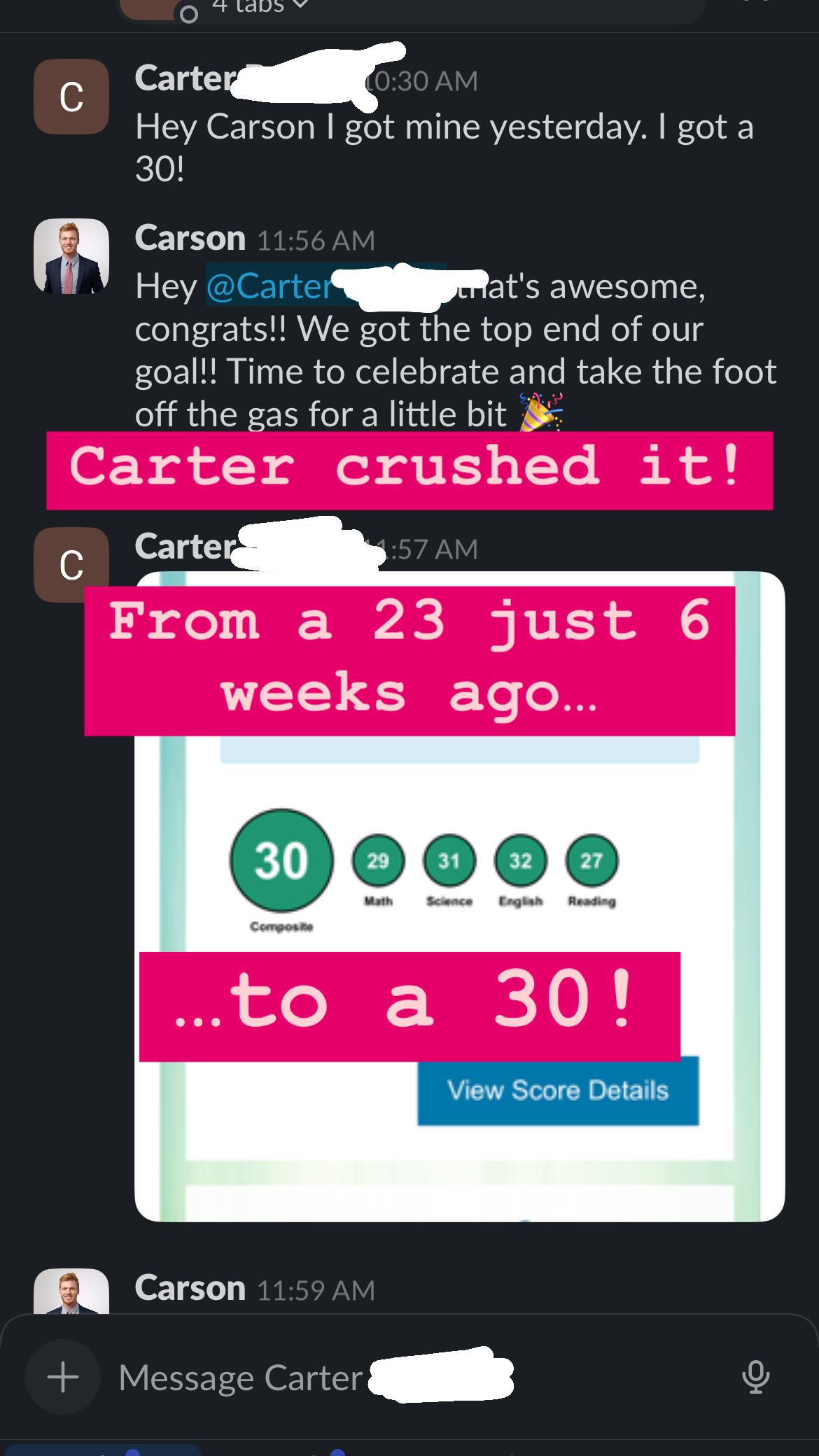
Slack screenshot - Carter's score improvement
Verified Result
Verified Result
Actual student coaching channel
Carter23 → 30
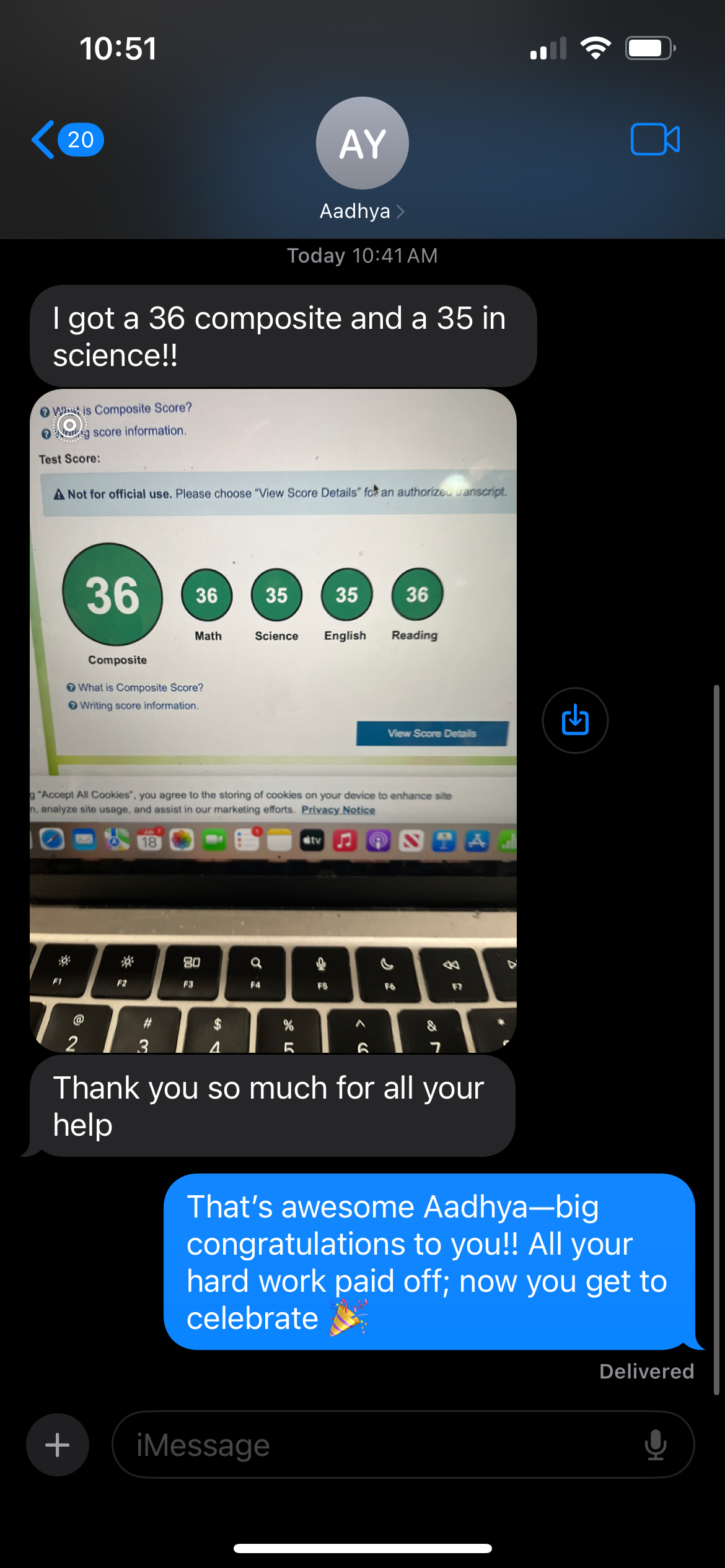
Slack screenshot - Aadhya's score
Verified Result
Verified Result
Actual student coaching channel
Aadhya36
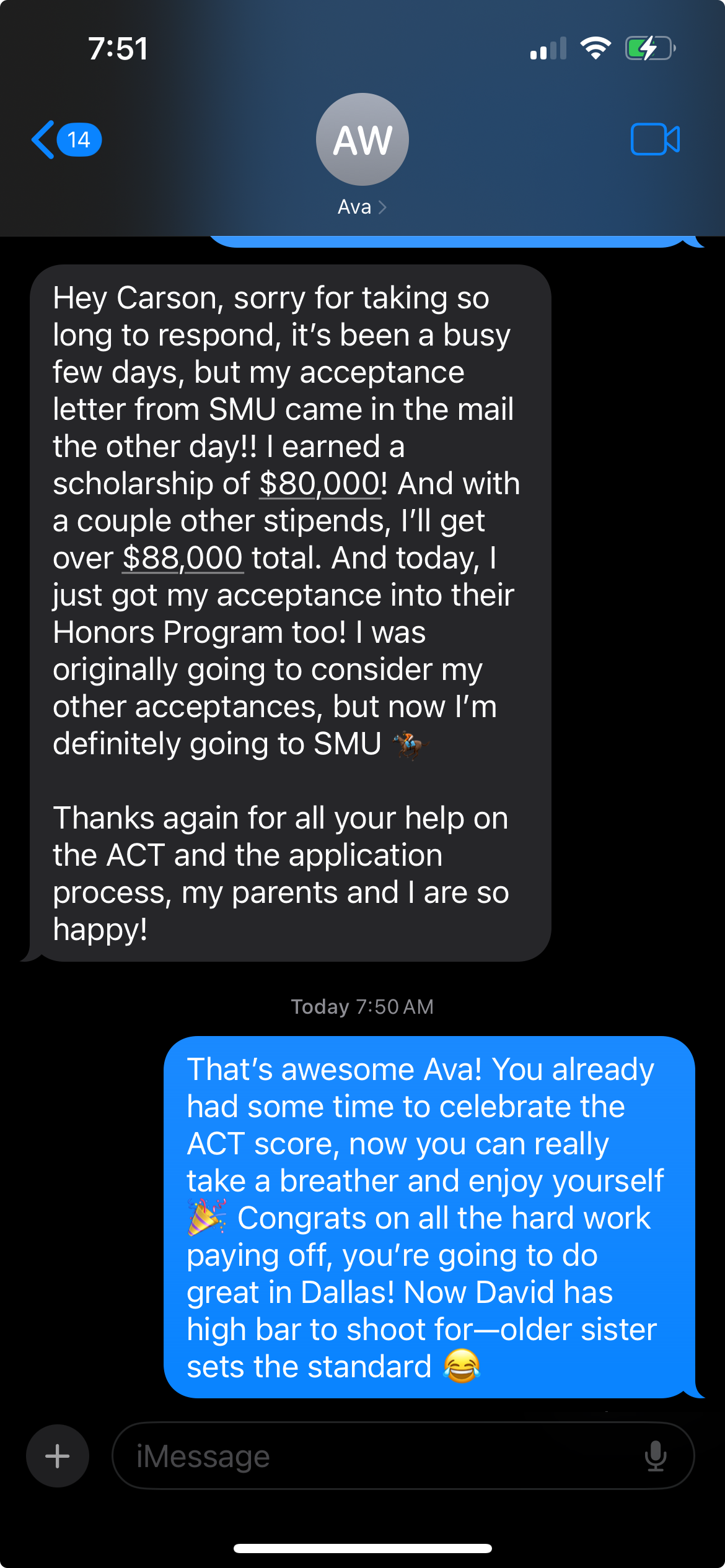
Slack screenshot - Ava's score improvement
Verified Result
Verified Result
Actual student coaching channel
Ava22 → 30
Slack screenshot - Morgan's score improvement
Verified Result
Verified Result
Actual student coaching channel
Morgan27 → 32
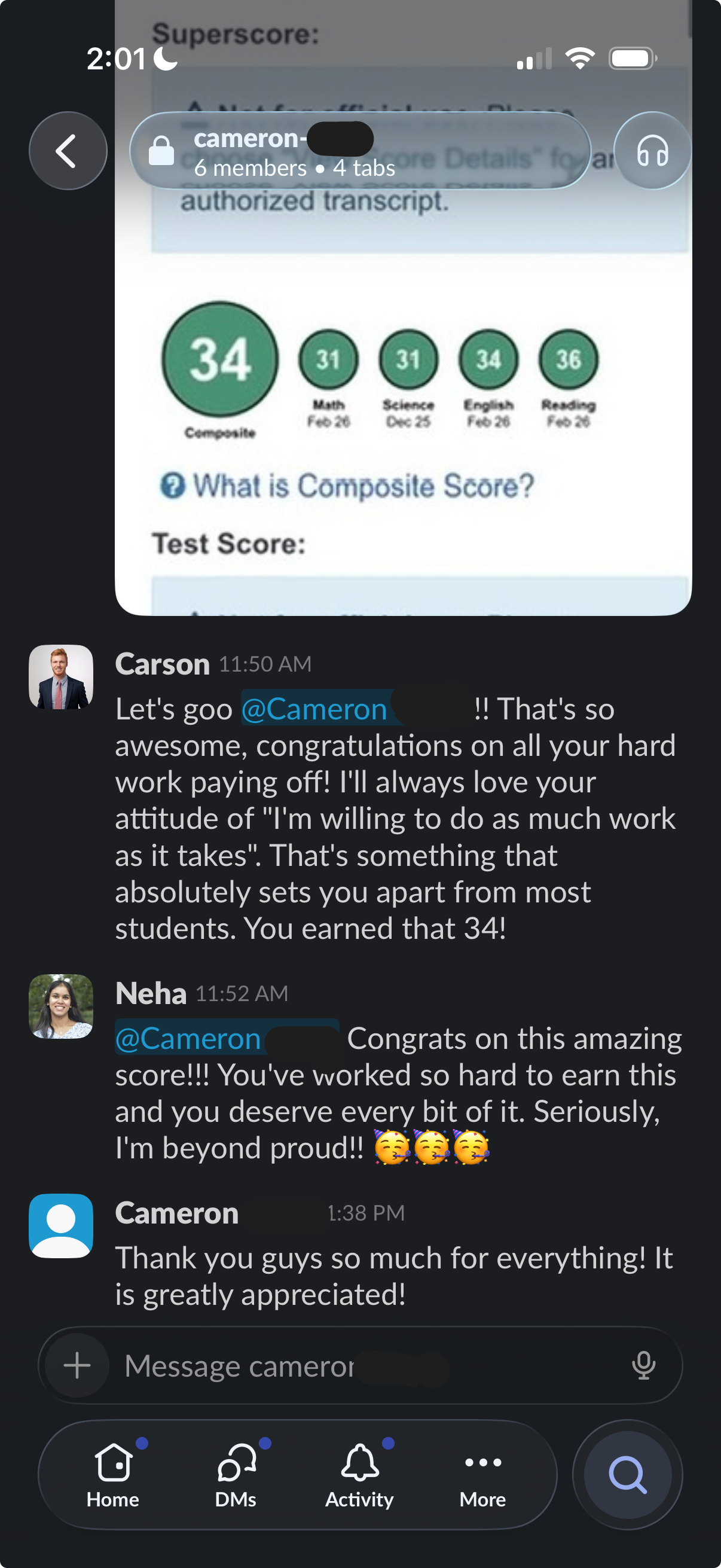
Slack screenshot - student score improvement
Verified Result
Verified Result
Actual student coaching channel
Isabella30 → 34
💰 The Real Math

What an ACT Score Actually Costs and Earns

The cost of any ACT prep program is a fraction of the scholarship swing on the line.

$24,000/year

University of Alabama

A 30 on the ACT automatically qualifies an out-of-state student for $24,000 per year, or $96,000 over four years. No essay. No "saving the world." Just hit the score.

Full tuition4 years

Florida Bright Futures

Florida residents at a 24 get 75% tuition at any public state school. At a 29, it's full tuition. Robert went 21 to 29 with us and got a full ride to UCF.

$88,421total

SMU (Ava 22 → 30)

Ava came to us at a 22 thinking standardized tests "weren't for her." She finished at a 30 and unlocked $88,421 at her dream school. Six weeks of work.

$60,000total

Auburn (Brown 24 → 34)

The 10-point swing from her old classroom course score to her final score at Auburn unlocked $60,000 in scholarship money on top of admission.

$134,000total

Marquette (Mia 25 → 33)

Mia's previous tutor spoon-fed answers that didn't stick. 10 weeks with us. 25 to 33. Accepted to 10 of 10 schools she applied to.

$234,264full ride

University of Kentucky (Meredith 30 → 35)

Meredith plateaued at a 30 after a generic premium prep course. Targeted coaching took her to a 35, a full ride plus housing stipend over four years.

Each ACT point is worth roughly $10,000 in scholarship value on average. A 5-point swing routinely unlocks $50,000+ in tuition. The fee for any prep program is a small fraction of that math.

Want our team to map out the scholarship math for your student's situation?

Get Your ACT Gameplan
Common Questions

Princeton Review vs Boosted Brains: Frequently Asked Questions

Straight answers to the questions parents ask on the call.

Is Boosted Brains a direct Princeton Review competitor?

Both of us prep students for the ACT, so on the surface, yes. Princeton Review built its name on big classroom courses across a bunch of standardized tests like the SAT, GRE, MCAT, and LSAT. We're focused on the ACT (with a smaller college advising arm), and we deliver it as 1-on-1 sprint coaching: daily personalized practice, async coach messaging, and a 4-8 week finish line built around your student's specific test date.

How is sprint coaching different from a Princeton Review classroom course?

A Princeton Review classroom course teaches the same material to everyone in the room, at the pace of the room. Sprint coaching gets built backward from one student's diagnostic. Every drill targets the question types that specific kid is missing. If your student already knows fractions, we skip fractions entirely and go straight to whatever's actually costing them points.

We already finished a Princeton Review course and the score barely moved. Will Boosted Brains work?

Yes, and this is one of the most common situations families come to us with. When a classroom course doesn't move the score, it usually means the curriculum wasn't pointed at that specific kid's weak spots. We start with a diagnostic, find the highest-leverage question types they're missing, and drill those. Brown came to us at a 24 after a group ACT class kept her stuck. She finished at a 34 and earned $60,000 in scholarships at Auburn.
Our student only has 4-8 weeks before the next test. Is that enough time?

Yes. 4-8 weeks is the exact length of one of our sprints. The program is designed around that window because that's how long real score gains take when the practice is actually targeted. Sarah went from a 25 to a 33 in 6 weeks. Isabella went from a 30 to a 34 in 3 weeks right before her senior-year September test.

How much does Boosted Brains cost compared to Princeton Review?

Princeton Review prices their classroom courses and private tutoring separately, and rates vary by location and package. We charge a flat program fee based on your student's current score, target score, timeline, and how much coaching support they need. On the call you'll get an exact quote and a realistic point target before you decide anything.

Does Princeton Review's classroom format ever beat 1-on-1 coaching?

Sometimes, yes. If your kid genuinely thrives on peer-group energy, learns by watching other students answer questions, and you want the lowest-commitment way to introduce them to the ACT before investing in something more intensive, a Princeton Review classroom course can be the right starting point. Most of the parents who find us want something faster and more personalized than that. But the classroom model fits some students well, and we'll tell you straight up on the call if it sounds like a better fit for yours.

Can my student do both: Princeton Review for content and Boosted Brains for coaching?

Technically possible, but in practice it dilutes the sprint. The whole point of sprint methodology is that your student spends about an hour a day on practice that's targeted at their specific weaknesses. Adding a separate classroom course on top means hours of practice that aren't pointed at the highest-leverage question types. Pick one approach and go all-in.

What's the right next step if we're deciding between Princeton Review and Boosted Brains?

Book a free call with our team. We'll look at your student's current score, the schools and scholarships you're targeting, and the test date you're aiming for. If sprint coaching is the right fit, we'll show you exactly what the plan looks like. If Princeton Review or another option fits better, we'll say so. About a quarter of the families we talk to don't end up working with us because the timing or fit isn't right, and we'd rather tell you that upfront than waste your time.

🎯 Your Next Step

Work With a Coach Who Scored a Perfect 36

If sprint coaching is the right fit for your student, the call will save you weeks of research. If it isn't, we'll tell you what is.

Book Your Free ACT Gameplan Call