Committed to play football and baseball at Johns Hopkins; offers from multiple top academic schools including UChicago
Chose: Johns Hopkins University
Ryder R started ACT prep in September of his junior year. The skeptical reaction from his classmates was the standard one: isn’t that way too early? Aren’t you supposed to do this senior fall, or summer after junior year at the earliest?
Starting that early is the part most families get wrong in the other direction. Most students don’t actually pick up prep until spring of junior year, summer, or even fall of senior year. By the time the typical student starts cramming, the calendar has already eaten most of the room to actually improve.
Ryder didn’t want to be that student. So he started in September. With one specific catch: he also played football. Whatever plan we built had to fit around practice, lifts, film, and game days, with zero negotiation on the athletic side.
What 10 weeks looked like
We did 10 weeks. Daily personalized plan focused only on the question types Ryder was still missing—nothing generic, nothing he’d already locked in. The schedule flexed around football: heavier on light practice days, lighter on game weeks, with Slack messaging access in between so Carson could answer questions whenever Ryder actually had a minute.
The big shift in the sprint wasn’t content. It was timing and accuracy on the question types that show up over and over and that a lot of students keep missing in the same predictable ways. Once those locked in, the score jumped.
24 to 33. Nine points in 10 weeks, during football season, as a junior.

What 33 unlocked
Once he had the score, the recruiting picture changed. College coaches started showing up with real interest, and Ryder ended up with offers from multiple top academic schools, including the University of Chicago.
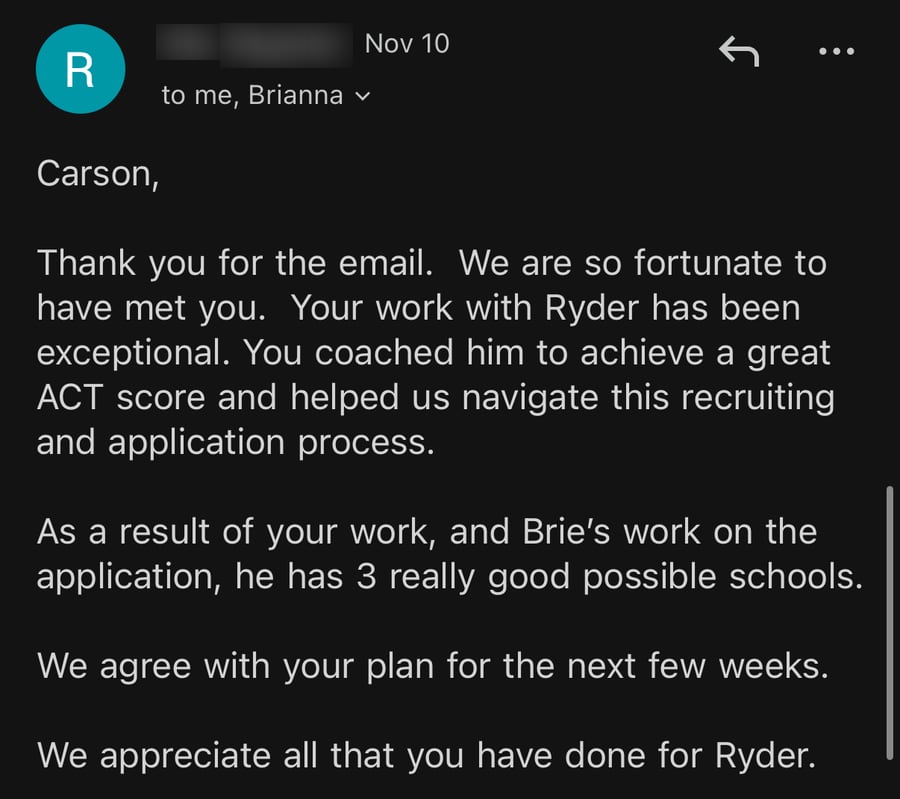
He committed to play football and baseball at Johns Hopkins.
The senior-year part most people don’t talk about
Most students grind on the ACT through senior fall. Ryder didn’t. By the time his peers were stressing about test dates, college applications, and how to fit prep into an already-loaded fall schedule, Ryder was just playing football and going to school. The test was done. The recruiting was done. The pressure was off.
That’s the under-discussed advantage of finishing early. The 33 was the headline. The senior year that didn’t have ACT prep stress wedged into it was almost as valuable.
What Ryder R’s story shows
The students who finish their ACT before senior year tend to be the ones who started early enough to take the time pressure off the calendar. September of junior year is “too early” by the usual prep-program calendar—but that’s exactly why it works. Sprint coaching is built for this shape: eight to ten focused weeks, scheduled around the rest of the student’s life, with a finish line in sight from day one.
If your student is an athlete with a real schedule, or just a junior who’d rather get the ACT done before senior year actually gets hard, this is what that path looks like.
What we did differently
- Started in September of his junior year—long before most peers would even think about ACT prep.
- Built a daily plan tight enough to fit around football practice and games.
- Targeted only the question types he was still missing—no wasted reps.
- Sprint structure meant he finished the ACT well before senior year started.
- Coordinated with college advising once the score was locked in to position him for recruiting.
Coached by
Carson
Every Boosted Brains coach has a perfect or near-perfect ACT score and has been personally trained by Carson Weekley (perfect 36) and Martin (Head of Student Success).