Unlocked full-ride scholarship opportunities at multiple top schools
Sarah was the kind of student who should have been a 33 on her own. All honors, top of her class, excellent GPA, the kind of work ethic that made teachers comfortable handing her independent projects. She also had every reason to believe she could study her way to a great ACT score with a thick prep book and some discipline.
She tried that. For weeks. The prep book sat open on her desk. She worked through it. The score didn’t move.
By the time she got on a call with Boosted Brains in early September, the goal she’d had at the start was modest: hit a 30. She’d been a 25 for long enough that 30 felt ambitious.
Why the prep book hadn’t worked
The prep book wasn’t the problem—the format was.
A 600-page ACT prep book is built to cover everything. It teaches every question type, every concept, every section, with the same generic level of attention to all of it. Which means it can’t tell Sarah which of those things she actually needed.
She was working hard. She was working broadly. She wasn’t working narrowly.
Without structure, every drill was the same shape: do the page, check the answers, move on. Patterns in her mistakes never got surfaced. Specific weaknesses never got named. She wasn’t getting more skilled at the ACT—she was getting more familiar with a prep book.
That’s a real difference. A lot of strong students get stuck in exactly this spot.
What six weeks of coaching changed
Sarah was paired with Neha, who runs the same playbook for self-directed high-achievers: structured daily plans, clear priorities, daily accountability.
The first thing that changed was the what. Instead of doing the next page in the prep book, Sarah did the specific drills that targeted the specific question types she’d been quietly missing. The patterns in her mistakes—the ones the prep book never could have flagged—surfaced inside the first week.
The second thing was the order. Neha kept the priorities narrow. Not “review everything.” Not “redo the practice tests.” Just the specific small set of weaknesses that were costing the most points, drilled until they stopped happening.
The third thing was accountability. Daily check-ins meant Sarah didn’t have to be her own project manager anymore. The plan said what to do today, and Neha was there at the end of the day to check on it.
She fell into a rhythm in week one and stayed in it for six weeks.
First test inside the program: a 33
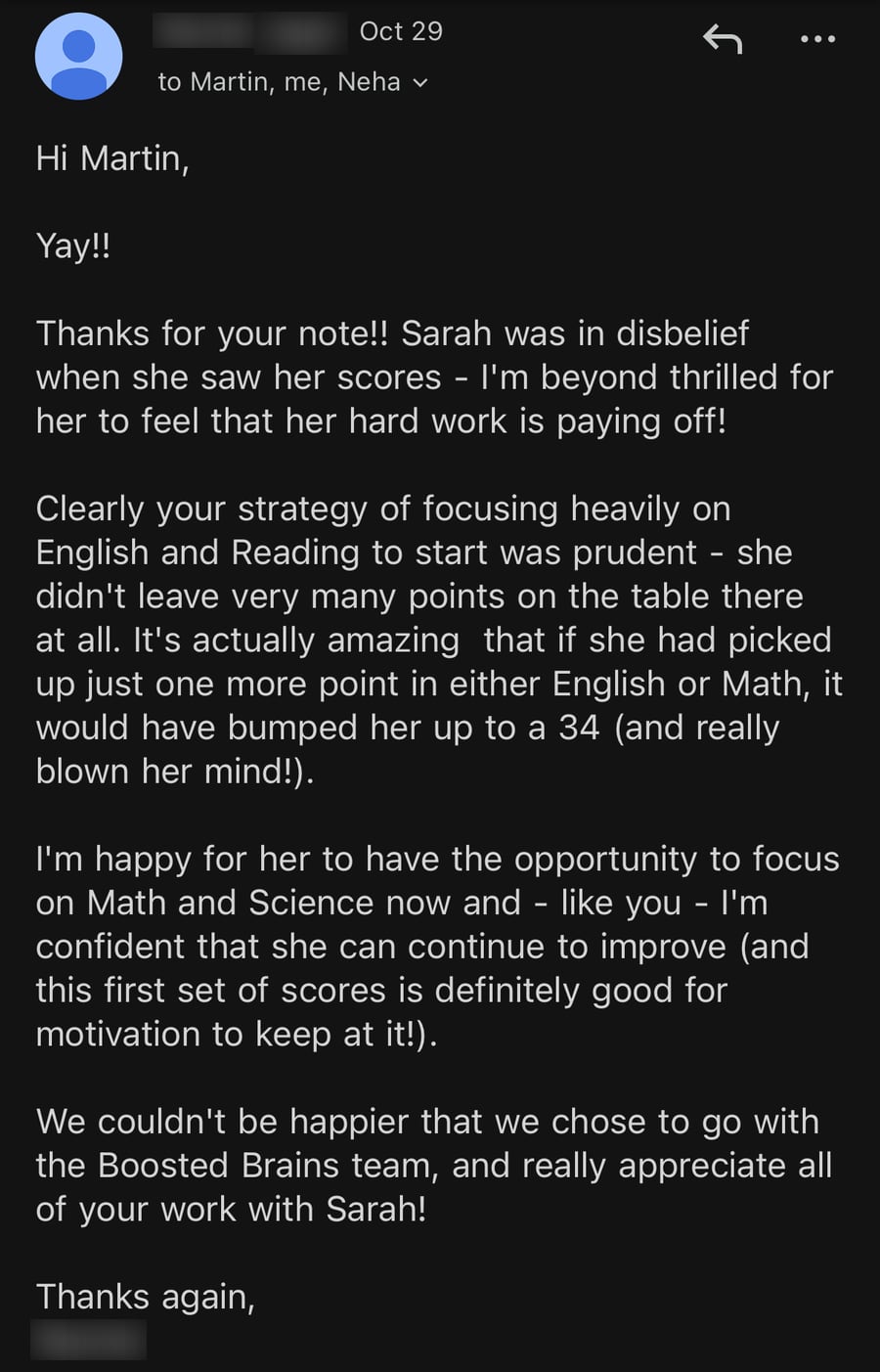
Sarah took her first ACT inside the program after that six-week sprint. She scored a 33.
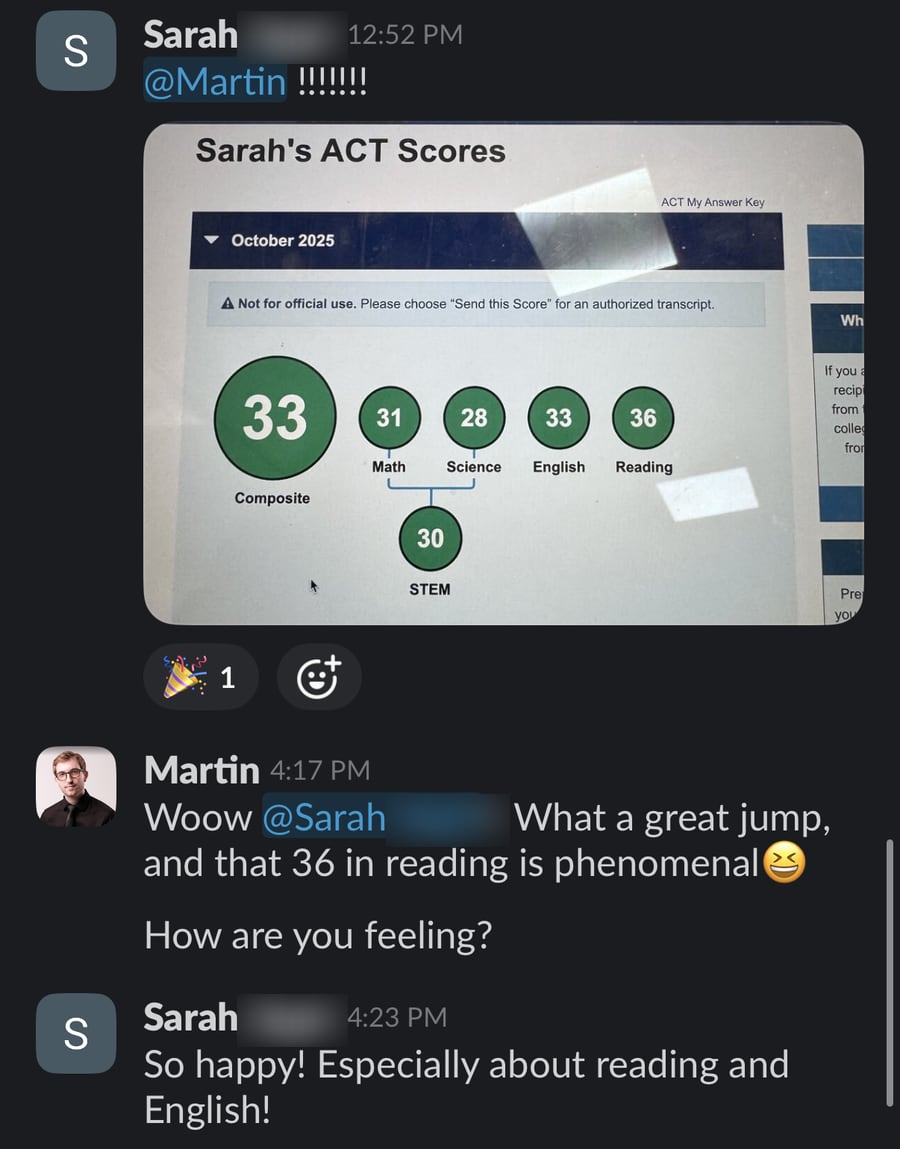
Eight points up. Three points past her original goal of 30. On the first test inside the program.
That score alone moved her from “trying to be competitive” at her target schools to actually competitive at top-tier and Ivy League schools.
The next test: 34
Most students would have stopped at the 33. That’s already a strong outcome. Sarah didn’t, because at her score level the math kept getting more interesting—each additional point opens up more schools and more scholarship money.
So we ran a focused follow-up. Same model, narrower targets: only the one or two sections still costing her points, drilled until those gaps closed.
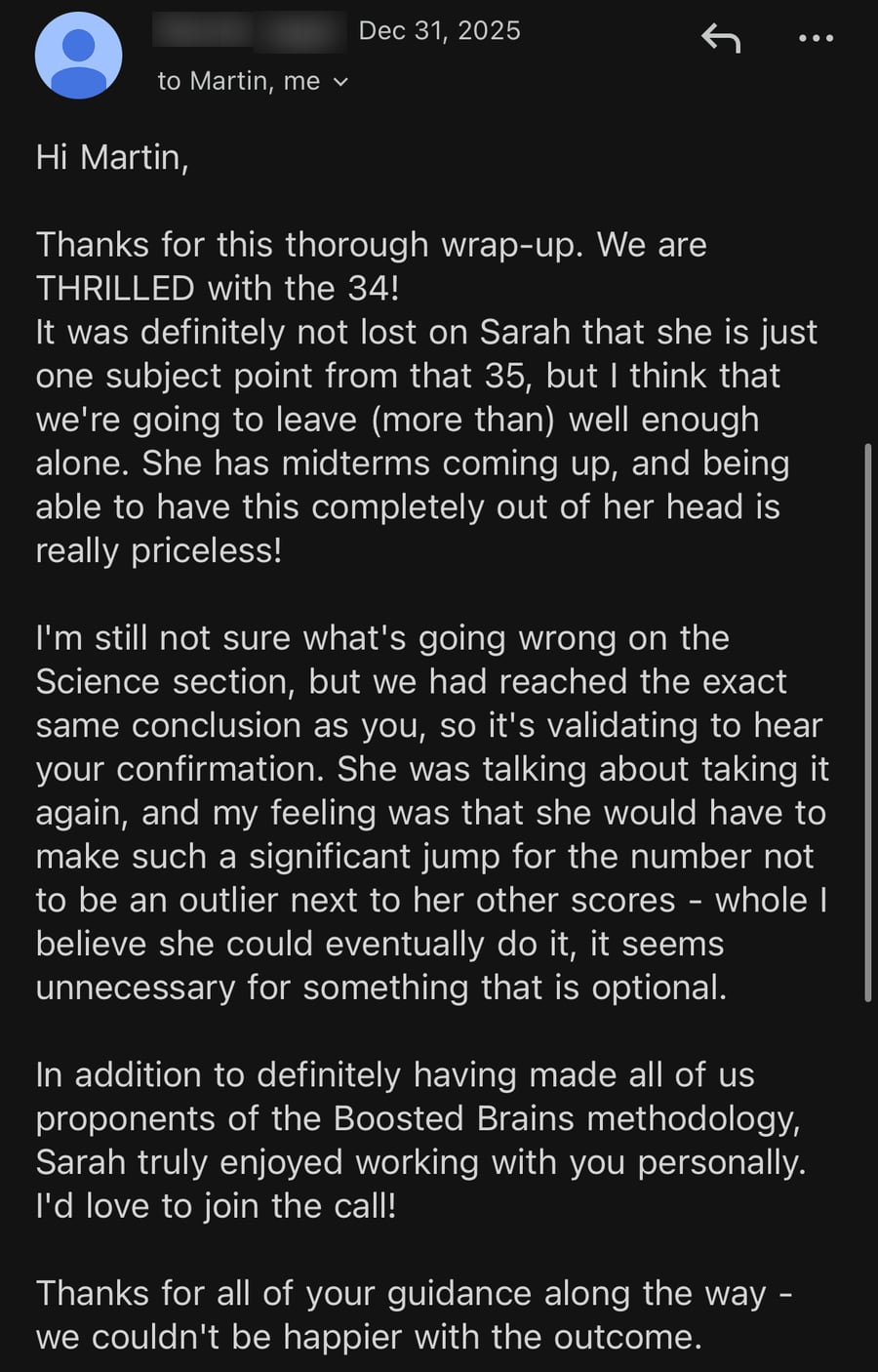
She took the ACT again and scored a 34.
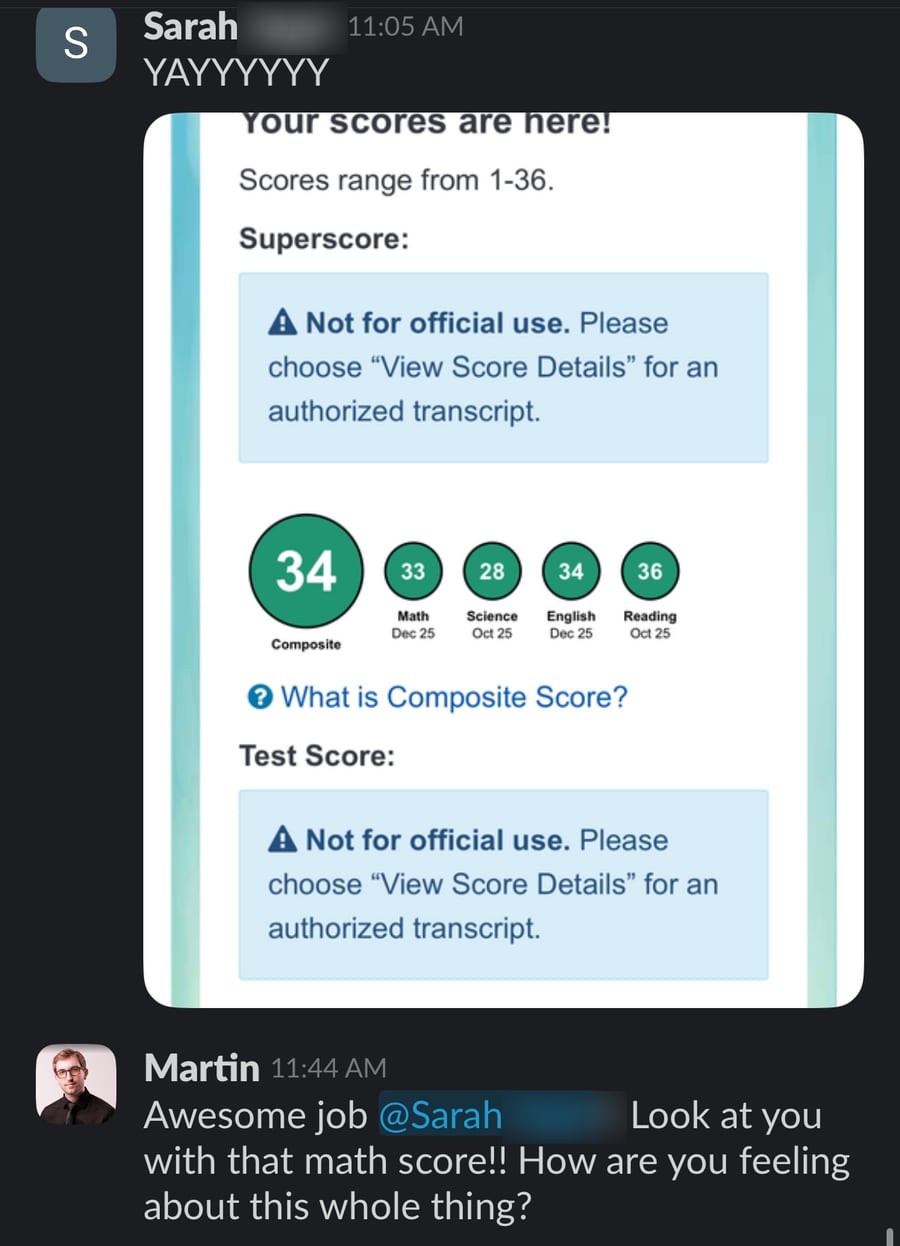
Total improvement: nine points. From a 25 stuck on a prep book to a 34 competitive at every school on her list. Full-ride scholarship opportunities that weren’t on the table at a 25 are now real options across multiple schools.
What Sarah’s story shows
Smart, self-directed students often try to skip the coaching step because they’ve always been able to figure things out on their own. That instinct works for a lot of academic challenges. It works less well for the ACT, because the test rewards a very specific kind of pattern recognition that’s hard to develop alone with a prep book.
The other thing worth pulling out: the path from 25 to 34 wasn’t one giant leap. It was a sprint to 33, then a focused follow-up to 34. Each stage had a clear target. That’s the shape of coaching when it works—not one all-or-nothing test date, but a strategic stack of test attempts where each one is built on the lessons of the last.
If your student is a high-achiever stuck at a number that doesn’t match her grades, the issue almost certainly isn’t effort. It’s structure. This is what structure looks like when it actually works.
What we did differently
- Walked away from the massive ACT prep book she'd been grinding on alone.
- Replaced 'figure it out on your own' with a structured daily plan tied to specific priorities.
- Neha ran daily check-ins, kept the priorities ruthlessly narrow, held the line on accountability.
- Identified the specific question types she'd been missing repeatedly in the prep book but never noticing.
- After the 33, pivoted prep to the one or two sections still holding the score back—then hit 34 on the next test.
Coached by
Neha
Every Boosted Brains coach has a perfect or near-perfect ACT score and has been personally trained by Carson Weekley (perfect 36) and Martin (Head of Student Success).