William is a senior from the Nashville area, and he rows. His ACT score was going to matter for recruiting: his mom told us he was trying to get a 32 to get recruited to row. When he started with us in June, the score he had was a 22.
By October he had a 33. Getting there took three tests, and one of them went badly.
A 22 with no preparation
William took his first ACT in March without preparing for it at all, and scored a 22. He ran out of time on the Reading section.
He’d had some ACT help before, but it hadn’t amounted to much. A tutor worked with him the summer before, when he had no test planned. Then his school ran a group ACT class every Sunday in the fall, covering one section a week. “Everyone kind of treated it as a joke,” William said. “No one really cared that much about it, unless you actually had an ACT coming up.” The class was big, so there wasn’t much one-on-one help, and it didn’t spend much time on the questions students got wrong.
He started with us in June, the summer before his senior year, with what he called “a little bit of hesitation.” His plan was to see how the July test went before deciding whether the program was worth it.
Every missed question, every week
His coach, Will, worked with him one-on-one. Over the summer, William did three to four timed practice sections a week, against one a week in his school’s class.
Will made reviewing mistakes the center of the work. After every practice test, William went back over each question he missed, worked out exactly why he missed it, and decided how he’d handle that kind of question next time. As Will put it, the point is “not just recognizing that you got it wrong, but going back and figuring out exactly why, and also how to approach that the next time.”
In July, William scored a 29, seven points higher than in March. His Math was a 33 and his English a 31.

That settled his question about the program. “The July one worked out pretty well,” he said later.
When school started in August and his weeks filled up, Will cut his practice to one or two full practice tests a week and kept their weekly meetings, so the ACT kept moving without crowding out his classes. “I think it was done very well about being able to manage when I had busier weeks,” William said. “It was a little bit more laid back, but still on top of it, especially with the meetings.”
Homecoming weekend
William took the ACT again in September and walked out feeling great. “I felt super good about it,” he wrote to Will the next day. “If that was my last test I wouldn’t be surprised.”
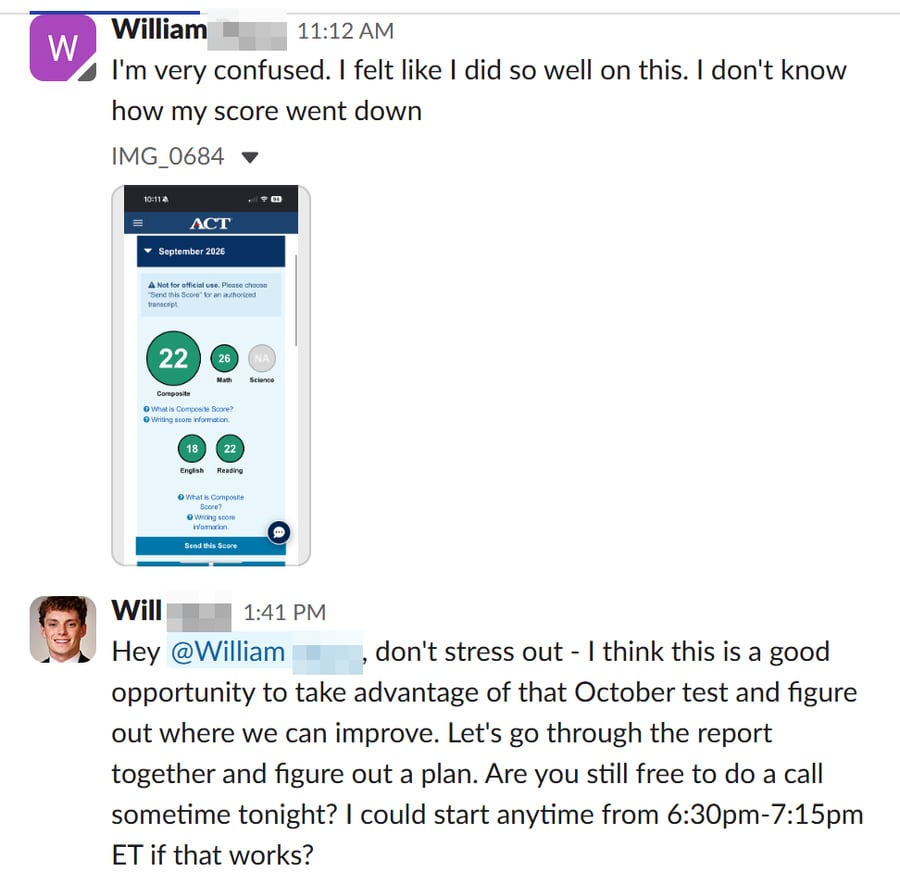
The test fell on homecoming, the morning after a football game, and he hadn’t gotten much rest. Looking back, he also thinks he went in “a little too cocky.” When the scores came out on October 6, he had a 22 again.
Eleven days to the October test
Will replied within a few hours and set up a call for that evening. They went through the score report together, and Will saw that William knew the material. “I think you have all the right knowledge right now in your head,” he told him. William’s practice tests backed that up. “I get like a 23 on the official one,” he said, “but then I go in and rip a 35, 36 on the practice.”
So Will built the 11 days before the October test around how William would walk into the room. He started with the overconfidence: “Sometimes if you’re too confident going into a test, that might actually have a negative impact on your score,” he told William. “I think a little bit of anxiety can be helpful.” He also told him to put September behind him: “Forget about it, move on, next play. I’m confident that going into October, we should be good.”
A week later, they worked on the mindset itself. Will wanted him “calm and confident and prepared,” and treating the real test like one more practice test at home. William practiced breathing and stretching during a full-length practice test, and the day before the test Will sent him a checklist for test day. William summed up the plan himself: “On the real test, I just need to have the same mindset of, oh, it’s just a practice test.”
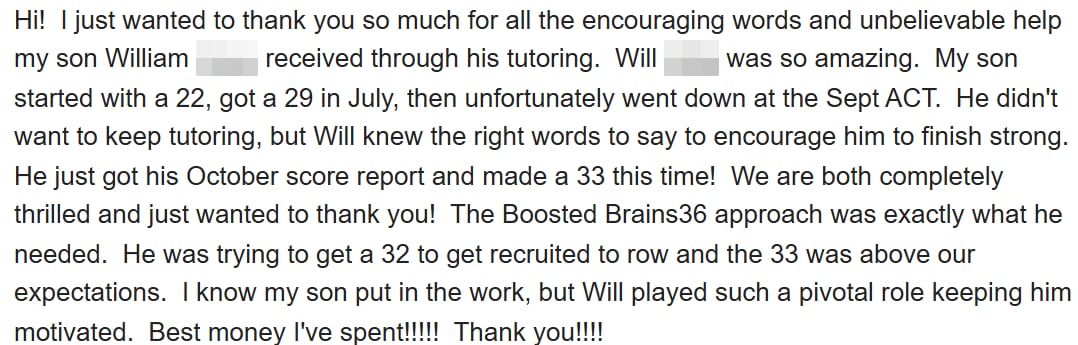
His mom saw the difference. “He didn’t want to keep tutoring,” she wrote to us later, “but Will knew the right words to say to encourage him to finish strong.”
A 33 in October
William took the October test on the 17th. The next day, Will checked in.
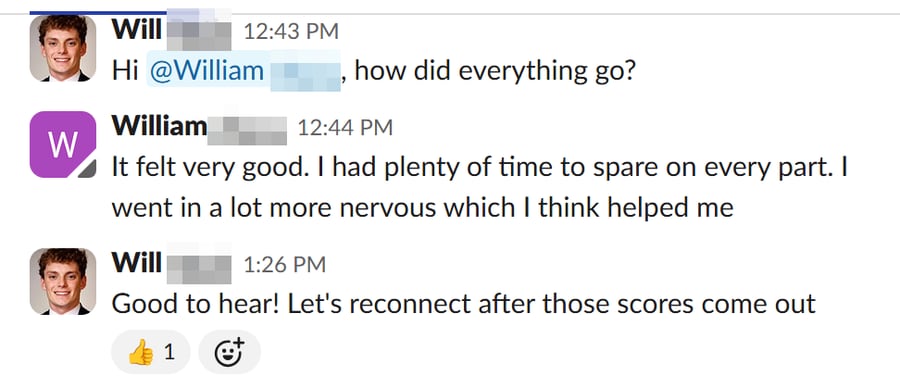
Plenty of time to spare on every part included Reading, the section he had run out of time on in March.
Scores came out on October 27. William opened his at school with his friends around him, “and then we were all freaking out.”
He had scored a 33. His Reading was a 34, eleven points higher than in July. His English and Math held at 31 and 33.
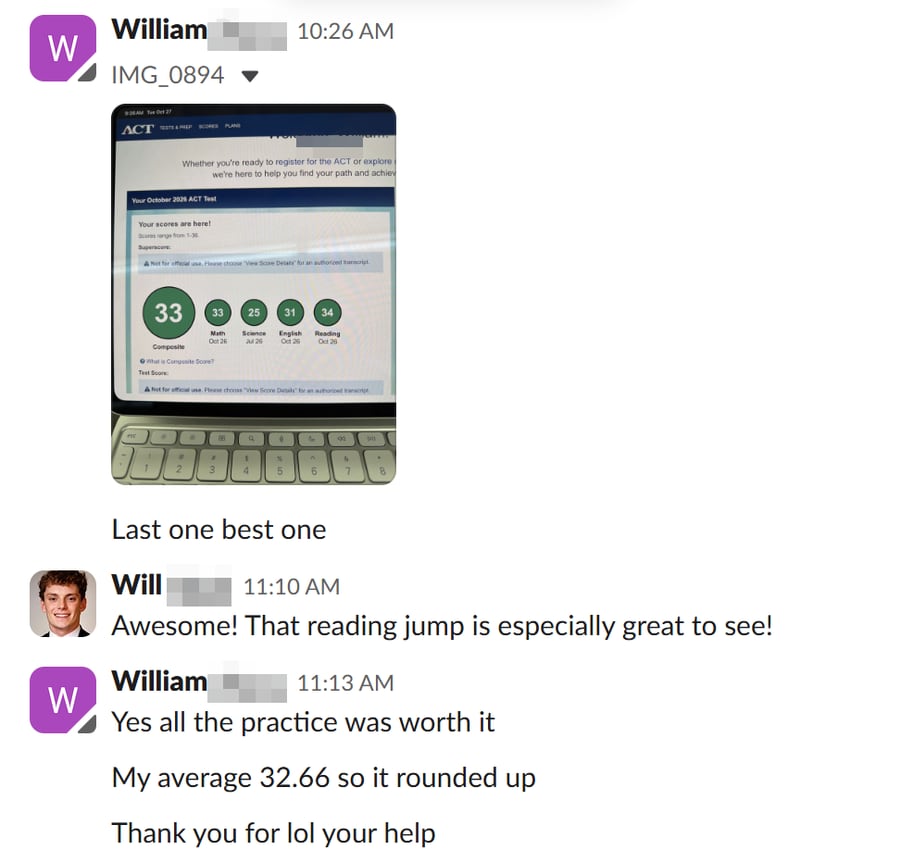
That’s eleven points higher than his March test, and eleven points higher than September. A 33 puts him in the 98th percentile of students who take the ACT.
His mom wrote to us a couple of days later.
Princeton, Georgetown, and Alabama
“Going from a 22, the options were pretty low,” William told Will in November. “Now, being at a 33, it opens the door. I might be able to actually go row at Princeton or Georgetown.”
He has applied to Princeton through restrictive early action, an early application that means he can’t apply early to other private colleges, and he interviewed in November. Georgetown’s rowing coach is recruiting him.
He has also been accepted to the University of Alabama. Alabama’s Presidential Scholarship for out-of-state students is worth $28,000 a year, and it goes automatically to students with a 32 or higher on a single ACT and a 3.50 GPA. William hasn’t been awarded it yet, but Alabama told him he’s “a pretty high applicant” for it based on his score.
Asked whether he’d recommend the program, William said: “I definitely would. I think this is a very good program if you’re willing to put in the work.”
Looking back, the one thing he’d change is when he started. Finishing the ACT as a junior, he said, “would have taken a lot of stress off during the start of the school year, when all the Common App stuff is due. So I kind of wish I started sooner. That’s what I’ve been telling all the juniors.”
What we did differently
- Coached him one-on-one, with three to four timed practice sections a week over the summer.
- Had him go back over every question he missed after each practice test, work out why, and plan how to handle it next time.
- Scaled his practice down to one or two full tests a week once senior year got busy, and kept the weekly meetings.
- Met with him the day his September scores came out, saw the knowledge was there, and built the October plan around his mindset on test day.
- Practiced walking in calm and prepared, with breathing and stretching during a full practice test and a checklist for the morning of the test.
Coached by
Will
Every Boosted Brains coach has a perfect or near-perfect ACT score and has been personally trained by Carson Weekley (perfect 36) and Martin (Head of Student Success).